The Ultimate Guide to the Wild

Experience of Culture in Tanzania

An Experience of Culture in Tanzania

For the modern traveler, a journey to East Africa is no longer just about counting the “Big Five” from a distance. In this year , the focus has shifted toward meaningful, destination-anchored engagement—the kind that happens when you step out of the jeep and into the rhythmic heart of a community. A Tanzania cultural safari is an experience of Undugu (brotherhood), where the vibrant traditions of over 120 ethnic groups weave together to create one of the most diverse human landscapes on the planet.

This is not a performance; it is a shared moment. It is the realization that while the Serengeti’s plains are vast, the stories of the people who call them home are even deeper.


The Red Shuka: Beyond the Dance in a Maasai Boma

Maasai culture is iconic, but the experience today is far more intimate and conversational than the postcards suggest. Standing in a Boma (homestead) made of earth and wood, you aren’t just watching the famous “Adumu” jumping dance; you are learning the philosophy behind it. You’ll sit with the elders to discuss the challenges of 21st-century conservation and join the women as they create intricate beadwork, where every color—red for bravery, blue for energy—serves as a visual language. A Tanzania cultural safari here is a lesson in resilience, showing how a community maintains its warrior spirit while embracing sustainable tourism and modern education.


Ancestral Echoes: Tracking with the Hadzabe

Near the rugged shores of Lake Eyasi, the experience takes a primeval turn. The Hadzabe, one of the world’s last true hunter-gatherer tribes, speak a rhythmic click-language that feels like the very heartbeat of the earth. Joining a morning forage is a high-energy immersion. You move through the bush at a trot, watching as they find wild honey in ancient baobabs or track game with hand-crafted bows. This part of a Tanzania cultural safari is visceral and raw, stripping away the noise of the digital world to remind you of the fundamental connection between humans and the land.


The Spice Pulse: Swahili Soul in Stone Town

On the coast, the culture shifts to a sophisticated blend of African, Arab, and Indian influences. Stone Town is a sensory labyrinth where the air is heavy with the scent of cloves and the sound of the Adhan (call to prayer) echoing over the rooftops. The experience is defined by “Pole Pole” (slowly, slowly). You’ll wander through narrow alleys too small for cars, run your hands over massive, brass-studded Omani doors, and join a local family for a Swahili cooking class. From the bustling fish auctions at Darajani Market to the peaceful “Sunset Dhow” cruises, this chapter of a Tanzania cultural safari is a poetic exploration of a maritime civilization that has welcomed the world for two thousand years.


The Melting Pot: Community Life in Mto wa Mbu

For a glimpse into the unity of modern Tanzania, the village of Mto wa Mbu offers a unique walking or “Tuk Tuk” adventure. Here, over 120 different tribes live and work in a single green oasis near Lake Manyara. The experience is a kaleidoscope of daily life. You’ll visit rice paddies and banana plantations that grow 30 different varieties, watch Makonde carvers transform ebony into art, and perhaps share a glass of traditional “mbege” (banana beer). It is a vibrant, bustling example of the “Ujamaa” (familyhood) spirit that unifies the nation, proving that diversity is Tanzania’s greatest strength.


The Etiquette of Connection

To move through a Tanzania cultural safari with grace, the experience is guided by a few simple, respectful rhythms:

  • The Power of Jambo: In Tanzania, the person always comes before the business. Never skip the greeting; a warm “Habari” (How are you?) opens every door.

  • The Right-Hand Rule: Whether you are receiving a gift or sharing a meal, always use your right hand as a sign of respect.

  • Modesty as Respect: Especially in rural areas and the coastal Swahili regions, dressing modestly (covering shoulders and knees) is a silent way of saying “I honor your traditions.”


Why This Stays With You

A Tanzania cultural safari doesn’t end when you fly home. It lingers in the way you value community and the slow pace of a conversation. You return with more than just photos of lions; you return with the laughter of a Chagga coffee farmer on the slopes of Kilimanjaro and the steady, ancient gaze of a Datoga blacksmith. It is an experience that reminds you that despite our different worlds, we all share the same sky.


Best Safari in Tanzania

Tanzania Safari Tours & Packages for Adventure

Whether you are a seasoned traveler, a new explorer, or somewhere in between, Asili Explorer Tanzania Safari offers the Tanzania Safari Tours of your dreams. Explore the stunning landscapes and diverse wildlife of Tanzania with our expertly curated safari packages. Your next great adventure awaits!

This Package is perfect for spotting major Earth Shows on wilderness Surfaces where photographer Enthusiasts get a nice photogenic.
As the name of this 7-day Luxury flying in Tanzania Safari indicates, this itinerary is a fly-in / fly-out Luxury safari that uses two domestic …
Tanzania is a well-known destination for wildlife photography lovers. It has a variety of…
Destinations to be visited: Tarangire, Serengeti, Ngorongoro Crater, Lake Manyara, and Materuni waterfalls.
Tanzania Luxury  Honeymoon Safari is perfect for celebrating Your weding ceremony also creates a lifetime experience.
This Itinerary is perfect for Spotting Wildebeest giving Birth to their Sibling. It provides a…
Tanzania Season Overview

When is the best month to visit Tanzania?

Tanzania in January

It is time to experience the natural beauty of Tanzania in all its magnificent, bursting, colorful glory. From January, you can enjoy luscious landscapes and once-in-a-lifetime photography opportunities that will take your breath away!

Tanzania in February

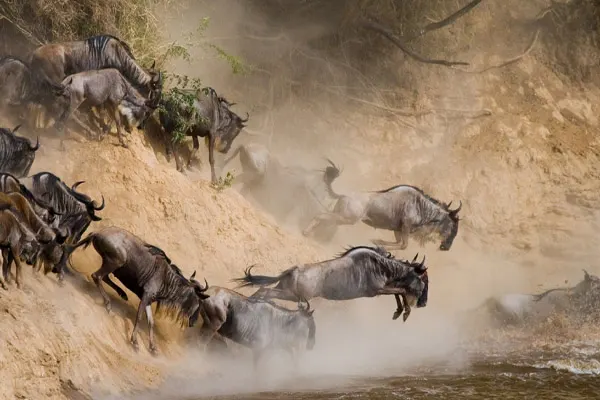
February in Tanzania is an incredible time to spot young animals taking their first steps along the savannah. The best places for this are Ndutu, where millions of wildebeest congregate and give birth over a short period known as calving season. Whilst thunderstorms may occur during the afternoons, the rain will allow for a transformation in the landscape.

Tanzania in March

March is an often-overlooked time of year to visit Tanzania. Offering plenty of spectator opportunities, with beautiful birding and low crowds! While it’s hot sometimes (and humid), you can witness all sorts of wildlife out & about during this period – including their babies too!

Tanzania in April

Tanzania is a photographer’s paradise in April. Scenic green landscapes, young animals, and colorful birds line the roads to greet travelers who come here for their visit during this period! The weather may be unpredictable during April, but the rewards are worth it with the sightings and landscapes.

Tanzania in May

If you want to see what life is like in Tanzania’s National Parks before the dry season, then now is your last chance. Witness beautiful green forests and wild grassy plains full of young animals during May, just before the landscape transforms.

Tanzania in June

June in Tanzania is a great time to visit and explore the dry landscape. Visitors will find many opportunities for wildlife viewing as animals cluster around watering holes during this month. The days are cool whilst sunny, providing just enough moisture without being too wet or dusty from windy conditions like those found later on in the year.

Tanzania in July

Visiting Tanzania in July comes highly recommended if you are looking to enjoy a Safari the way it was meant to be done. With dry land becoming more scarce, animals can be found congregating near watering holes and can easily be spotted due to the arid landscape.

Tanzania in August

The long, dry season is over, and the animals have had a chance to recharge themselves. August in Tanzania provides an opportunity for you that doesn’t come around often-a great chance to see wildlife up close!

Tanzania in September

One of the best times to visit Tanzania is in September, when there’s better visibility and the sun is shining. The end of the long dry season means that animals are desperate for food, making it more likely you’ll see action on your safari!

Tanzania in October

October is the end of Tanzania’s long dry season, and this means it’ll be time for some serious animal action! With thick clusters of animals to see on any given day trip or more extended stay in one spot. You can travel through parks without worrying about getting stuck behind somebody others as there isn’t much traffic at all during these months. Perfect if you’re looking forward to an authentic Tanzania safari atmosphere.

Tanzania in November

The Tanzania landscape is set to be spectacular in November as nature springs back into life during the short rainy season. With rivers overflowing and animals scurrying about in search of food, it will make for some fantastic wildlife viewing opportunities that you won’t want to miss out on!

Tanzania in December

December is the perfect time to visit Tanzania and witness this fantastic country’s natural beauty. The birds will be in full glory as they return from their annual migration after being away all year long! Finish your year in warmth, comfort, and natural beauty by visiting Tanzania in December.

Wild Testimonials

Tanzania Safari Reviews

Linda V
Linda V
Oct 30, 2022
My daughter (21) and I (52) did the Machame trail (10 oktobre 2022) on the Kilimanjaro. It was amazing! We had a great team and thanks to them we had a great week (we did the 7 days trip, including the acclimatisation dat, which I would suggest) and thanks to the whole crew we made it to the summit.
Linda V
Linda V
Oct 30, 2022
My daughter (21) and I (52) did the Machame trail (10 oktobre 2022) on the Kilimanjaro. It was amazing! We had a great team and thanks to them we had a great week (we did the 7 days trip, including the acclimatisation dat, which I would suggest) and thanks to the whole crew we made it to the summit.
Linda V
Linda V
Oct 30, 2022
My daughter (21) and I (52) did the Machame trail (10 oktobre 2022) on the Kilimanjaro. It was amazing! We had a great team and thanks to them we had a great week (we did the 7 days trip, including the acclimatisation dat, which I would suggest) and thanks to the whole crew we made it to the summit.
Linda V
Linda V
Oct 30, 2022
My daughter (21) and I (52) did the Machame trail (10 oktobre 2022) on the Kilimanjaro. It was amazing! We had a great team and thanks to them we had a great week (we did the 7 days trip, including the acclimatisation dat, which I would suggest) and thanks to the whole crew we made it to the summit.